
Cold call script: 8 B2B scripts with buyer replies
A cold call script has four short parts: the opener, the reason and the problem, an interest question and the meeting ask. For each part you also prepare a next line for what the buyer is likely to say. Below are eight scripts for common B2B situations with those replies.
· 12 min read
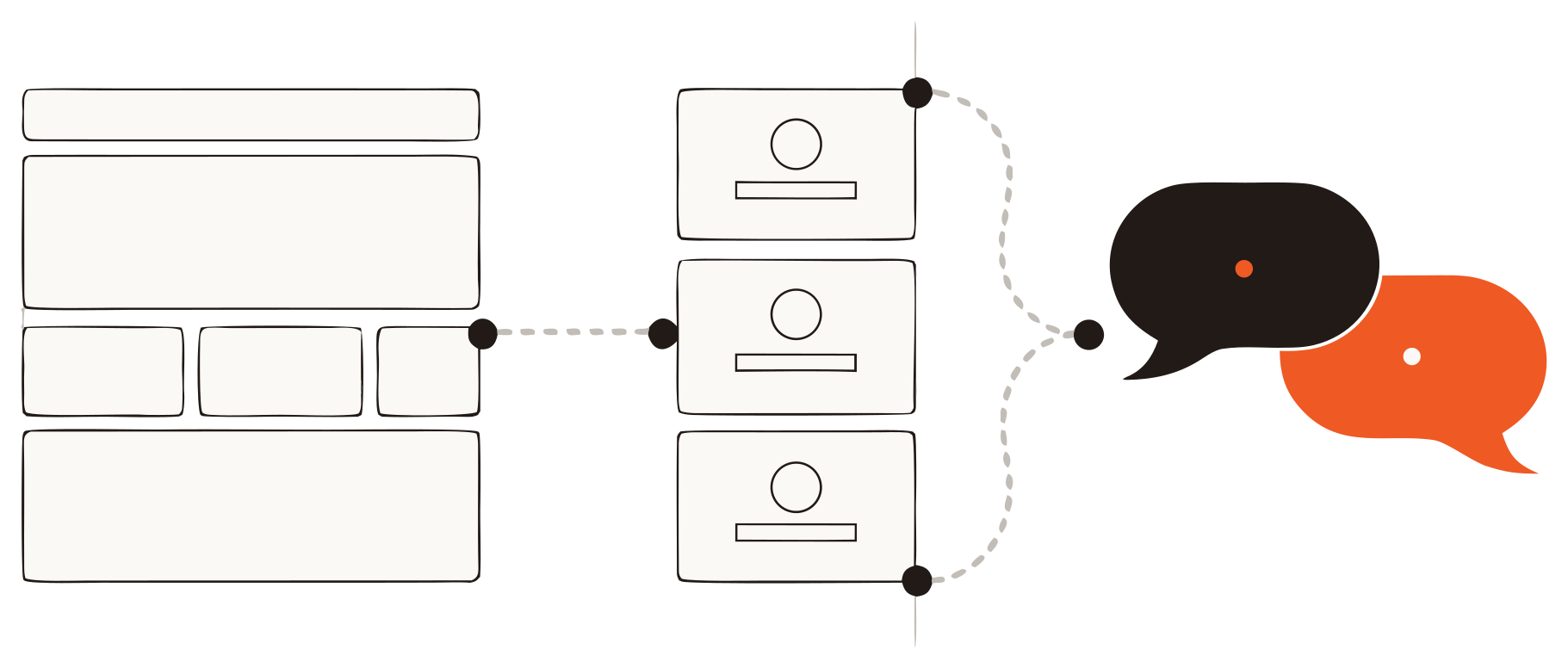
The four parts of a cold call
Every script below uses the same four parts. The goal of the call is a meeting, so anything that doesn’t lead to one gets cut.
| Part | Time | What you say |
|---|---|---|
| 1. Opener | ~10 s | Who you are, that this is a cold call, and a request for 30 seconds |
| 2. Reason and problem | ~20–30 s | One problem people like them have, in their words, and one sentence on how you fix it |
| 3. Interest question | ~5 s | “Is that something you’re dealing with?”, asked before you ask for time |
| 4. Meeting ask | ~10 s | A specific day and time instead of “sometime next week” |
In Gong’s analysis of 300M+ cold calls, “Did I catch you at a bad time?” had a 2.15% success rate, “How’s your day going?” 7.6%, a permission-based opener 11.18% and “Heard the name tossed around?” 11.24%. In Gong’s earlier study of 90,380 calls, saying “the reason for my call is…” raised the success rate 2.1×.
For the problem part, 30 Minutes to President’s Club advise describing one problem in detail and fixing it in a sentence: “If you nail the problem, you only need one sentence to make it go away.”
The average cold call lasts 82 seconds. Calls that book a meeting run about six minutes.
One product, eight situations
Every script here is filled in for the same example. Swap in your own product with the template below.
Sam sells an accounts-receivable tool that automates invoice reminders and flags customers likely to pay late. The buyer is Dana, controller at a 120-person freight company. Sam leads with this problem: the finance team spends hours chasing the same late invoices by email and learns that a big customer will pay late only after it happens.
1. The first call: permission-based opener
Use it when the buyer has never heard of you. This is the base script, and the others change one part of it.
Hi Dana, it’s Sam from Arbor. This is a cold call. Can I take 30 seconds to tell you why I’m calling, and you tell me if it’s worth another minute?
…Okay, go ahead.
The reason for my call: most controllers I talk to at companies your size tell me two things. The team spends Monday mornings chasing the same twenty late invoices by email, and they find out a big customer is paying late only after it happened.
We automate the reminders and flag the accounts that are slipping, so the chase list gets shorter and nothing big surprises you. Is any of that true for you, or is collections in good shape?
The chasing part, yes. It’s one person’s whole Monday.
Then it’s worth 20 minutes to see if we can give her that Monday back. Does Thursday at 10 work, or is Friday at 2 better?
What they say back, and your next line
| Buyer | You |
|---|---|
| “Who is this?” | “Sam, from Arbor. We haven’t spoken before, it’s a cold call. 30 seconds and you decide?” |
| “I’m in a meeting.” | “Then I’ll be quick: is this afternoon or tomorrow morning better?” Book the callback and don’t pitch. |
| “Collections is fine.” | “Good to hear. How do you find out today that a big account is about to pay 60 days late?” |
| “What does it cost?” | “It depends on invoice volume, and that’s the first thing we’d work out on Thursday. Roughly how many invoices a month?” |
Hi Dana, how are you today? I’m Sam from Arbor, we’re a leading AI-powered accounts-receivable platform helping finance teams…
Hi Dana, it’s Sam from Arbor. This is a cold call. Can I take 30 seconds, and you tell me if it’s worth another minute?
In the first version Dana waits through a title and a slogan before she hears why you called. The second says what the call is and lets her decide whether to keep listening.
2. “Heard the name tossed around?”
Use it when you already sell to similar companies, so the question is plausible. It had the highest success rate in Gong’s data. Both “yes” and “no” lead straight to the reason for the call.
Hi Dana, it’s Sam from Arbor. Have you heard our name tossed around?
No, can’t say I have.
Ha, guess we’re not as famous as I thought. Well, the reason for my call: we work with finance teams at a few freight companies in the Midwest on late invoices…
| Buyer | You |
|---|---|
| “No.” | A self-deprecating line (adapted from 30MPC), then “the reason for my call”. |
| “Yes, I think so.” | “Nice. Then you probably know we do invoice reminders. The reason I’m calling you specifically is…” |
| “Should I have?” | “Not really, we’re small. It’s a cold call. Can I have 30 seconds?” |
3. Calling after an email
Use it when the buyer is in a sequence and got your email a day or two ago. Don’t ask “did you get my email?”: most people don’t remember, and the question puts them on the spot. Mention the email as context and move on. In Gong’s data, calling raised email reply rates from 1.81% to 3.44% even when nobody picked up.
Hi Dana, it’s Sam from Arbor. I sent you a note on Tuesday about late invoices, no reason you’d remember it. Can I give you the 30-second version, and you tell me if it’s relevant?
| Buyer | You |
|---|---|
| “Didn’t see it.” | “No problem, that’s why I called. Short version: …”, then the problem line. |
| “Saw it, not for us.” | “Fair. Was it the timing, or is chasing invoices not a problem for your team?” |
| “Remind me what it was?” | The problem line and the interest question. Don’t re-read the email. |
4. Calling about a trigger
Use it when something changed at the company: a job post, a new hire in the buyer’s team, an acquisition, a new office. A trigger tells the buyer why you called them and why now. It has to be specific and checkable. “I saw you’re growing” is too vague to count.
Hi Dana, it’s Sam from Arbor, this is a cold call. I saw you posted two openings for AR specialists last week. Usually that means late invoices are growing faster than the team. Is that what’s going on, or is it something else?
Partly. We also lost someone in September.
Got it. The reason for my call: we take over the reminders those roles spend most of their day on…
The opener ends with your guess about why the trigger happened. Dana either confirms it or corrects you, and in both cases she is now talking about her team.
5. Getting past the gatekeeper
Use it when a receptionist or an assistant picks up. Be polite and direct, and don’t claim you know the buyer. 30MPC suggest three steps: ask to be put through like a regular caller, give context if they ask what it’s about, and add social proof if they push.
Hi, could you put me through to Dana Ortiz? It’s Sam.
What is this regarding?
I work with the finance teams at a couple of other freight companies in Ohio on late invoices. I wanted to see if it’s on Dana’s radar.
| Gatekeeper | You |
|---|---|
| “Is she expecting your call?” | “No, it’s a cold call. Is Dana the right person for collections, or is that someone else?” |
| “Send it to info@.” | “Will do. Whose attention should I put it to?” |
| “She’s not available.” | “When is she usually at her desk, early morning or after five?” |
After two refusals, stop. Try her direct line or mobile early in the morning or after 5 pm, or write to her by email or on LinkedIn.
6. “I’m not the one who handles this”
Use it when you reached the wrong person. Ask who handles it: your next call can then start with a name from inside the company.
That’s not me, honestly. AR is under our finance manager.
Thanks, that helps. Who is that?
Mark Chen.
Appreciate it. If I tell Mark you pointed me his way, is that okay? And is chasing invoices something he complains about, or am I guessing wrong?
The answer to the last question gives you the problem in their words for the next call. Then open with: “Hi Mark, it’s Sam from Arbor. Dana suggested I speak with you…”
7. Voicemail: two messages, then stop
Use it when nobody picks up, which happens on most calls. Voicemails rarely get a callback, but they raise replies to the email you send after them. In Gong’s data, a voicemail plus an email more than doubled the email reply rate (2.73% → 5.87%), and three or more voicemails dropped it to 2.2%. Keep the first one around 15 seconds and the second around 30.
First voicemail (~15 s)
“Hi Dana, it’s Sam Lee from Arbor. I’m calling about late invoices at Northwind. I’ll send you a short email with the details. Again, Sam Lee, 555-0142.”
Second voicemail, a few days later (~30 s)
“Hi Dana, Sam from Arbor again. A freight company about your size cut the time its finance team spends chasing invoices from a full day a week to about an hour. I wrote you the two things they changed. If it’s not relevant, reply ‘no’ and I’ll stop. Sam Lee, 555-0142.”
Say your name and number slowly, twice. Leave the pitch out and give only the reason for the call. The result in the second message has to come from a real customer. If you don’t have one yet, use the problem line instead.
8. When they push back
Most pushback on a cold call comes before the buyer knows what you sell. In Gong’s 300M-call study, 49.5% of objections were dismissive (“not interested”, “send me some information”, “call me in six months”), 42.6% were situational (budget, bandwidth) and 7.9% were about an existing solution. 30MPC’s advice is to handle the reaction before the objection: agree first, then ask one question.
“Not interested.”
I totally understand, but if you could just give me two minutes, I think you’ll see…
Fair, I did call out of the blue. Before I let you go: is it that late invoices aren’t a problem for you, or that now isn’t the time?
Dana says “not interested” before she knows what you do. When you agree, she has nothing to argue with, and the either-or question gets a real answer in one sentence.
If she says “not interested” a second time, end the call: “Got it, I’ll leave it there. Thanks for picking up, Dana.” Write down what she said. After a polite exit you can call again in three months. After a third push she is unlikely to pick up.
“Just send me an email.”
Just send me an email.
Happy to. So I send the right thing: is the bigger headache chasing invoices, or not knowing who’ll pay late?
The second one, if anything.
I’ll send a short note on that today. If it looks useful, could we pencil in 15 minutes on Thursday, and you cancel if it doesn’t?
“We already use [tool].”
We’re actually much better than [tool], because we have…
Makes sense, most teams your size do. If you could change one thing about how it handles late payers, what would it be?
If you attack her current tool, she defends her choice. Asking what she would change shows whether there is a gap you can fill.
“Call me in six months.” / “No budget.”
Ask what changes then: “Sure. What happens in six months, a new budget or a project wrapping up?” If there is a real event, book the call now: “Then let’s put 15 minutes in the calendar for the first week of May, and I’ll send you something useful before that.” If there is no event, treat it like a second “not interested”.
Price usually comes up later, in the meeting. When it does, ask “too expensive compared to what?” before you defend the number.
Write your own: the template
Copy the structure and fill each line with your product. The example column is the Arbor script from above.
| Part | Template | Example |
|---|---|---|
| Opener | “Hi [first name], it’s [your name] from [company]. This is a cold call. Can I take 30 seconds, and you tell me if it’s worth another minute?” | The same, word for word. |
| Problem | “Most [their role]s I talk to at [type of company] tell me [problem 1, in their words] and [problem 2].” | “…the team spends Monday mornings chasing the same twenty late invoices…” |
| Fix | “We [what you do] so [the problem goes away].” One sentence. | “We automate the reminders and flag the accounts that are slipping…” |
| Interest | “Is any of that true for you, or is [area] in good shape?” | “…or is collections in good shape?” |
| Ask | “Then it’s worth [20] minutes to see if we can [outcome]. Does [day, time] work, or is [day, time] better?” | “…give her that Monday back. Thursday at 10 or Friday at 2?” |
How to write the problem line
Use the buyer’s own words. A controller says “chasing invoices on Monday morning”, while a vendor says “optimizing the order-to-cash cycle”. You can find the buyer’s wording in your discovery call notes, in reviews of competitors and in job posts.
Name one problem, two at most, and pick the one your buyers mention most often. Give it details the buyer can picture: “the same twenty invoices”, “one person’s whole Monday”.
Practice the replies
Buyers can tell when you read. Say the script out loud until you stop thinking about the next words and can listen to what the buyer says.
- Say the opener and the problem line out loud ten times. Together they should take under 35 seconds.
- For each part, write down the three replies you hear most often and your next line. The tables above are a start.
- Roleplay every reply, especially “not interested” and “send me an email”.
- After real calls, note the line where each call ended. If eight calls end on the same line, rewrite that line and keep the rest.
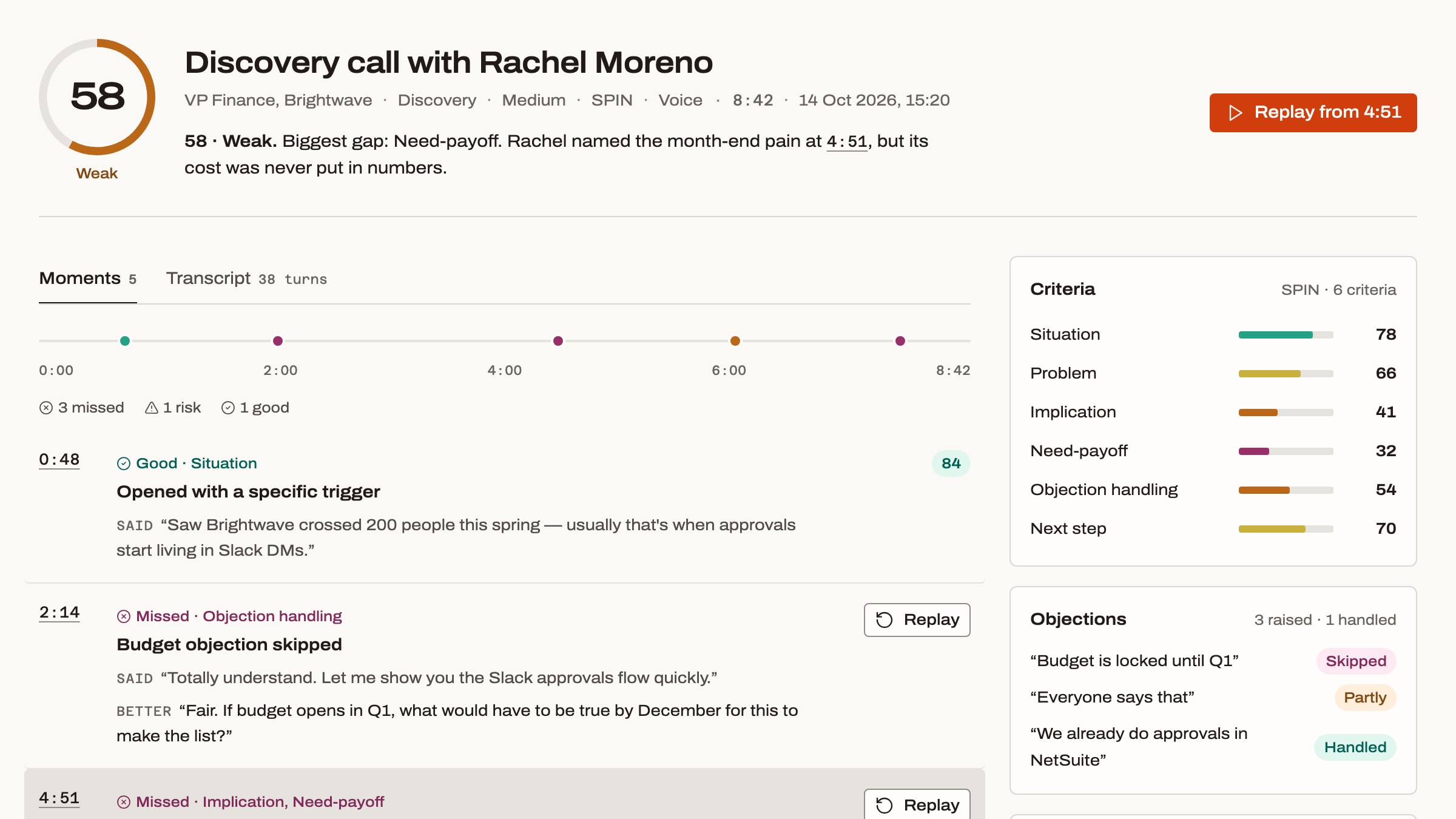
A colleague can play the buyer, but a colleague is polite and already knows your product. In SalesLab’s cold call practice you paste your product site and get a buyer built from it: busy, skeptical, with the objections your prospects raise. It brushes you off, asks for proof and can hang up. The debrief shows the second where the call went wrong, and you can replay that moment.
Practice this script on a buyer built for your product
Paste your site. In about a minute a buyer picks up: busy, skeptical, with your prospects’ objections. Voice or text, free.
Questions
How long should a cold call script be?
The scripted part (opener, problem, interest question and meeting ask) should take under a minute to say, about 120–150 words. For everything else, prepare short replies to what the buyer is likely to say.
Should I read the script word for word?
Learn the opener almost word for word, because the first ten seconds are when you are most nervous. For the rest, know the structure and the key lines and say them in your own words.
Is it okay to ask “how are you?” on a cold call?
In Gong’s data “How’s your day going?” had a 7.6% success rate, against 2.15% for “Did I catch you at a bad time?” and 11.18% for a permission-based opener.
What is the 3-3-3 rule in cold calling?
There’s no single definition. Most often it means about three seconds each for your name, your reason and your value. Sometimes it means a cadence of three calls, three emails and three social touches.
What is the best time to cold call?
Sources disagree. Cognism’s 2025 data shows 10–11 am and Thursday as best. Orum’s shows connect rates peaking around 10 am, with Tuesday and Wednesday strongest. Start mid-morning midweek, then check your own connect rates by hour.
Does cold calling still work in 2026?
In Gong’s 300M-call data, top reps turned 16.7% of conversations into meetings, and the average rep 4.6%.
Keep reading
AI sales roleplay
How SalesLab works: from a product link to a debrief
Five steps: paste your product link, get buyers built for it, talk to one, read the debrief, and replay the moment you lost the deal.
· 3 min read